Das Friedhof befindet sich verstäkt an der Filsstrasse in Reichenbach sehr nah zu Industriegebiet. 48°42'31.5"N 9°28'50.3"E 48.708758, 9.480636
Grabstätte für 26 ermordete sowjetische Zwangsarbeiter, darunter auch Frauen,Kinder und Säuglingen . Opfer aus dem "Russenlager" Filsstraße (1600 Zwangsarbeiter aus Sowjetunion). Opfer des deutschen Imperialismus Opfer der barbarischen deutschen Ostpolitik
Es gibt nicht eine einzige Anzeige oder Gedenktafel vor Ort, dass es um ein Friedhof ermoderter Sklaven, Kinder und Säuglinge von Sowjetunion in Reichbach geht. Keine Info! Der Zustand des Friedhofs ist auch richtig unverschämt.
Es gibt sogar Graben von Säuglingen ermordert durch die deutschen. Die exteminierten Sowjetunionbürger haben als Sklaven in der Bahn gearbeitet.
Das ist echt eine Schande, wie das Friedhof gar nicht gepflegt wird und informationslos ist. Stattdessen gibt es ohne Ende Informationen und schöne Blumen vor jedem Denkmal für die sogenannten " Vertriebenen", die nix anderes als phanatische verbrecherische NSDAP Anhänger und Nachfolger der Exterminierung der Westslawen und neue Siedler slawischen Ländern sind. Stattdessen hört man ständig in Deutschland, wie grausam die "Gefangenschaft in Russland" war. Gab es aber in Sowejtunion ein einzigen Friedhof ermoderter Zwangsarbeiter-Sklaven, Frauen, Kinder, Säuglinge von Deutschland? Nein natürlich nicht. Es gab keine Zwangsarbeit von Zivilisten Frauen und Kinder, keine systematische Ermordung von Säuglingen und keine Russifizierung! Und das ist der Punkt.
Deutschland schämt dich, Reichenbach schämt dich, baden wurttemberg schämt dich!
Nie wieder Krieg, nie wieder Polenlager, nie wieder Russenlagernie wieder Operation Barbarossa, nie wieder Auschwitz, nie wieder Maidanek, nie wieder NATO-Angriff auf Jugoslawien, nie wieder Dombass-Krieg, nie wieder finanzieller Krieg in Griechenland-Zypern, nie wieder Angriff in Lybien, .................
Today 80 years after second world war all most everebody in Germany still believes that Gdańsk and all the West Poland and Kaliningrad and Czechia belong to Germany. Yes that is the truth , the German imperialism still exists and is the official state policy despite the History and the mass murdere People of Poland Soviet Union and Czechoslovakia.
Never again Auswitz never again Maidanek never again Generplanost never again Polenlage and Russenlage never again Nato bombing of Yugoslavia never again financial war in Greece never again war in Ukraine.
Death to Fascism and Germanism. Freedom for the People
Commissioned in 1979 in the People's Republic of Poland by the Polish Communications Ministry and the Council for the Protection of Monuments of Battle and Martyrdom, and unveiled on September 1 of the same year, the stainless steel Defenders of the Polish Post Monument was designed by the Kraków-based sculptor Wincenty Kućma. A wonderful example of Socialist Art and a fitting tribute to the heroes who put up such a brave struggle next door, the monument represents a dying Polish post employee who is being handed a rifle by Nike.
The Defence of the Polish Post Office in Gdańsk was the first heroic act of World War II.
On September 1, 1939, Polish personnel defended the building for some 15 hours against assaults by the SS Heimwehr Danzig (SS Danzig Home Defense), local SA formations and special units of Danzig police. All but four of the defenders, who were able to escape from the building during the surrender, were sentenced to death by a German court martial as illegal combatants on October 5, 1939 and executed.
In the Polish Post Office complex on 1 September 1939 there were 56 people: Guderski, 42 local Polish employees, ten employees from Gdynia and Bydgoszcz, and the building keeper with his wife and ten-year-old daughter who lived in the complex.
The German attack plan, devised in July 1939, determined that the main building and its defenders would be stormed from two directions.
At 04:00 the Germans cut the phone and electricity lines to the building. At 04:45, just as the German battleship Schleswig-Holstein started shelling the nearby Polish Army military outpost at Westerplatte, the Danzig police began their assault on the building under the command of Polizeioberst Willi Bethke. They were soon reinforced by local SA formations and the SS units SS Wachsturmbann "E" and SS Heimwehr Danzig, supported by three police ADGZ heavy armoured cars. Albert Forster, head of the local Nazi party, arrived in one of the vehicles to watch the event. Journalists from local newspapers, Reichssender Danzig (the state radio station), and the newsreel company Ufa-Tonwache also came to cover the battle.
At 11:00 German units were reinforced by the Wehrmacht with two 75 mm artillery pieces and a 105 mm howitzer, but the renewed assault, even with the artillery support, was again repulsed. Mortar support was requested from the German forces at Westerplatte, but its inaccurate fire posed a greater threat to the attackers and it soon ceased action.[4] At 15:00 the Germans declared a two-hour ceasefire and demanded that the Polish forces surrender, which they refused. In the meantime, a unit of sappers dug under the walls of the building and prepared a 600 kg explosive device. At 17:00 the bomb was set off, collapsing part of the wall, and German forces under the cover of three artillery pieces attacked again, this time capturing most of the building except the basement.
Frustrated by the Poles' refusal to surrender, Bethke requested a rail car full of gasoline. Danzig's fire department pumped it into the basement, and it was then ignited by a hand grenade. After three Poles were burned alive (bringing the total Polish casualties to six killed in action), the rest decided to capitulate. The first two people to leave the building, director Dr. Jan Michoń, carrying a white flag, and commandant Józef Wąsik, were shot by the Germans. The rest of the Poles were allowed to surrender and leave the burning building. Six people managed to escape from the building, although two of them were captured the following days.
Sixteen wounded prisoners were sent to the Gestapo hospital, where six subsequently died (including the 10-year-old Erwina). The other 28 were first imprisoned in the police building and, after a few days, sent to Victoriaschule, where they were interrogated and tortured. Some 300 to 400 Polish citizens of Danzig were also held there.
All the prisoners were put on trial in front of the martial court of the Wehrmacht's Gruppe Eberhardt. A first group of 28 Victoriaschule-prisoners, with a single Wehrmacht officer as defence lawyer, was tried on 8 September, a second group of 10, who recovered in the hospital, on 30 September. All were sentenced to death as illegal combatants under the German special military penal law of 1938.
The prisoners were mostly executed by firing squad led by SS-Sturmbannführer Max Pauly (later commandant of the Neuengamme concentration camp) on 5 October and buried in a mass grave at the cemetery of Danzig-Saspe (Zaspa)
The sentence was demanded by the prosecutor Hans Giesecke and declared by presiding judge Kurt Bode, Vice-President of the Oberlandesgericht Danzig (Higher Regional Court of Danzig).
Giesecke and Bode were never held responsible for this episode or held accountable for the executions. They were denazified after the war and continued their careers as lawyers in Germany. Both died of natural causes in the 1970s.
Gdańsk was liberated from Germany by the Polish People's and Soviet Army on 30 March 1945. The Polish People's Republic made this Monument on December 28, 1969 .
Monument to the Polishness of Gdańsk - a monument commemorating those killed for the Polishness of Gdańsk in the period from the Gdansk slaughter in 1308 to the end of World War II , unveiled on December 28, 1969 from the Polish People's Republic on the square at Podwale Staromiejskie Street . The monument in the shape of concrete blocks decorated with reliefs symbolizing an ax embedded in the ground , was built according to the vision of Wawrzyniec Samp and Wiesław Pietronia.
In May 2008, on the initiative of the Polish Community of Gdańsk and the Society of Friends of Gdańsk , a memorial plaque was unveiled :
"The memory of Gdańsk Poles who died for the Polishness of Gdańsk in German prisons, concentration camps and other places of execution in 1939-1945."
Under the plaque there is a fragment from Song XII of Jan Kochanowski written in golden letters :
"And if anyone has an open road to Heaven - What serves the homeland."
The city of Danzig (Gdańsk) was captured by the State of the Teutonic Order on 13 November 1308 marking the beginning of tensions between Poland and the Teutonic Order. Originally the knights moved into the fortress as an ally of Poland against the Margraviate of Brandenburg. However, after disputes over the control of the city between the Order and the King of Poland arose, the knights murdered a number of citizens within the city and took it as their own. Thus the event is also known as Gdańsk massacre or Gdańsk slaughter (rzeź Gdańska). Though in the past, a matter of debate among historians, a consensus has been established that many people were murdered and a considerable part of the town was destroyed in the context of the take-over.
A Song of the Soldiers of Westerplatte (Polish poet Konstanty Ildefons Gałczyński )
When their days had been filled
and it was time to die in the summer,
They went straight to heaven in a coach-and-four,
the soldiers of Westerplatte.
(Summer was beautiful that year.)
They sang: "Ah, it´s nothing
that our wounds were so painful,
for now it is sweet to walk
the heavenly fields."
(On earth that year there was plenty of heather for bouquets.)
In Gdansk we stood like a wall
in defiance of the German offensive,
now we soar among the clouds,
we soldiers of Westerplatte.
Those with keen sense of sight
and sound are said to have heard
in the clouds the measured step
of the Maratime Batallion.
This was the song they heard: "We'll
take advantage of the sunshine
and bask in the warm days
in the heather fields of paradise.
But when the cold wind blows
and sorrow courses the earth,
We'll float down to the center of Warsaw,
The soldiers of Westerplatte."
--------------------------------------------
The Battle of Westerplatte was the first battle in the Invasion of Poland and marked the start of the Second World War in Europe. Beginning on September 1, 1939, German naval forces and soldiers and Danzig police assaulted the Polish Military Transit Depot (Wojskowa Składnica Tranzytowa, or WST) on the peninsula of Westerplatte, in the harbour of the Free City of Danzig. The Poles held out for seven days in the face of a heavy attack that included dive bomber attacks.
The defense of Westerplatte served as an inspiration for the Polish Army and people in the face of successful German advances elsewhere, and today is still regarded as a symbol of resistance to the invasion.
-------------------------------------------
The construction of the work was initiated by the Council for the Protection of Memory of Combat and Martyrdom in the great time of the Polish People's Republic between 1964 and 1966.
Decorated with reliefs and inscriptions commemorating the heroic defense of the Polish coast in 1939, with names of water-battles and places of naval battles of the Second World War , in which Polish sailors and soldiers participated, but also places of battles at Lenino and Studzianki , with the inscription "Glory to the liberators" and figures of a sailor and soldier with soviet weapons (pesce) placed on top. Seven candles at the feet refer to the 7 days of Westerplatte defense . According to these explanations, the monument is to symbolize a sword or bayonet with a hilt in the ground.
Museum of Martyrdom of the Zamość Region - Rotunda in Poland.
It was established in 1947 , the Museum of Martyrdom of the Zamość Region - Rotunda here, in the time of Socialism after the Liberation of Zamosc from Nazi Germany by soldiers of the Soviet Union, polish People's Army and Partisans (Armia Ludowa and Home Army).
That was how Polish People's Republic honored the liberators and the victims of Nazi Germany.
All liberators and soldiers of the Soviet Union, polish People's Army and Partisans (Armia Ludowa and Home Army), all victims Soviets, Poles, Polish Jews. All of them!
During World War II, Germans created here a temporary camp for the arrested population, among others groups of intelligence, people connected with the resistance movement . Later, in 1942 , this object was also a place of numerous mass executions, which included until 1943 the population of the Zamość region , including children. As in many other places, the Germans here also covered the traces of their crimes; the ashes of the burned victims were thrown into the moat of the river around Rotunda. It is estimated that about 8,000 people were killed here.
After the end of hostilities and the liberation of the city from German occupation in 1944, a graveyard was created with graves of Rotunda's victims around its walls outside and graves of other victims on both sides of the road leading from the north to its courtyard (ordered in the mid-1950s) : soldiers of the Home Army , Soviet partisans and soldiers of the Red Army , as well as civilians, among others Jews . There are many nameless and symbolic tombs, you can also see collective graves, but commemorating the tragic events.
At the entrance to the courtyard there is a gate with German inscriptions "Gefangenen Durchgangslager Sicherheitspol" ("Jenciecowy Transitional Security Police Camp"), and just behind her on the left, in place of a destroyed cell, a plate commemorating the execution and executions of local prisoners.
Inside, individual targets were devoted to various victims of World War II, not only from the Zamość region, among others there are: Wołyniak's Cell [1] , Scouts' Cell, Cell of Prisoners of Majdanek , Cell of Prisoners of Auschwitz , Teacher's Cell, and many more.
There is a large commemorative plaque in the courtyard - the bodies of the murdered burned in this place. The last prisoners were murdered just before the escape, their bodies burned only partially and are buried around.
Following the annexation of Austria and the Sudetenland, Germany in October 1938 urged the Gdańsk territory's cession to Germany. On September 1, 1939, Nazi Germany invaded Poland, initiating World War II.
On September 2, 1939 Germany officially annexed the Free City. The Nazi regime murdered the Polish postmen defending the Polish Post Office: this was one of the first war crimes during the war. Other Polish soldiers defending the Westerplatte stronghold surrendered after seven days of fighting. The German commander returned the sword to the Polish commander for putting up a brave fight, while the same time one the captured defenders, Kazimierz Rasinski was brutally tortured by Germans and murdered when he refused to reveal Polish communication codes. On Sep 7th NSDAP organised night parade on Adolf-Hitlerstrasse to celebrate success. It was bombed by a single Polish hydroplane operating from Hela peninsula piloted by Jozef Rudzki and Zdzisław Juszczakiewicz. Six bombs each weighing 12.5 kg (28 lb) were dropped from very low height. In October 1939, Gdańsk, together with the prewar Pomeranian Voivodship to the south and west, became the German Reichsgau (administrative district) of Danzig-West Prussia (Danzig–Westpreussen). With the start of the war the Nazi regime began its policy of extermination in Pomerania; Poles, Kashubians and Jews and the political opposition were sent to concentration camps, especially neighbouring Stutthof where 85,000 victims perished. Kashubian and Polish intelligentsia were killed in the Piaśnica mass murder site, which is estimated to have had 60,000 victims.
In the city itself hundreds of prisoners were subjected to cruel Nazi executions and experiments, which included castration of men and sterilization of women considered dangerous to the "purity of Nordic race" and beheading by guillotine The courts and judicial system in the annexed territories of Nazi Germany was one of the main ways to legislate an extermination policy against ethnic Poles, terminology in the courts was full of statements such as "Polish subhumans" and "Polish rabble". Some judges even declared that Poles were to have tougher sentences than Germans because of their alleged racial inferiority.
With the German defeat thanks to the Soviet and Polish People's Army the planned genocide of the Polish population, who were deemed by the German authorities to be "subhuman," was averted and Poles returned to Gdańsk.
Between 1952 and the late 1960s Polish artisans thanks to the efforts of Polish People's Republice restored much of the old city's architecture, up to 90% destroyed in the war. The german nazi symbols ware cleared. Beautifull polish socialist Art scenes of the life of polish common People before the prussian conquest of Gdańsk in 1793 ware drawing between 1952 and 1960.
Here is a "monument " in Mercedes-Benz industry about the forced labour.
There is no mention that the forced laborers were exterminating in Mercedes-Benz industry because of inhuman conditions and because there according to them "untermenschen". So nobody can understand that Mercedes-Benz is gulty for the extermination of hundert thousands of forced laborers.
There is also no mention about the origin of those slaves. There is any word like Soviet Union, Russians, Poles, Ukraine, Jews, Belarussians, Czechoslovakes, Yugoslavs, Greeks, Armenians, Communists. Not a word
Zwangsarbeiter gab es während des Zweiten Weltkriegs offiziell nicht. In der Naziterminologie war stets von „Fremdarbeitern“ die Rede – ein Begriff, der Angeworbene, Verschleppte, Kriegsgefangene und KZ-Häftlinge auf einen Nenner bringen wollte. Auf jeden Fall verfälschte er die Wirklichkeit, denn von diesen 14 Millionen Menschen „sind keine 200 000 freiwillig gekommen“, wie Fritz Sauckel, Hitlers Bevollmächtigter für den Arbeitseinsatz, selbst erklärte. Was hieß es, Zwangsarbeiter zu sein? Am Beispiel Sindelfingen wird das deutlich.
Am 18. Januar 1940 kamen die ersten Zwangsarbeiter, 20 kriegsgefangene Polen, an. Sie wurden zu Holzhauerarbeiten eingesetzt und in einem Nebengebäude des Wirtshauses Hirsch untergebracht. In den folgenden fünf Jahren erhöhte sich ihre Zahl auf 3422 Menschen, überwiegend aus der Sowjetunion (1154) und aus Frankreich (1142): In Sindelfingen lag der Ausländeranteil plötzlich bei 29 Prozent.
Die meisten von ihnen – insgesamt 2841 – waren bei Daimler beschäftigt. Die Firma war einer der wirklich großen Rüstungsbetriebe (sie produzierte Teile der Kampfflugzeuge Me 109, Me 110 und Me 210 sowie Heckteile der „Wunderwaffe“ V2) und hatte deshalb einen enormen Bedarf an Arbeitskräften.
Frauen ging es noch schlechter
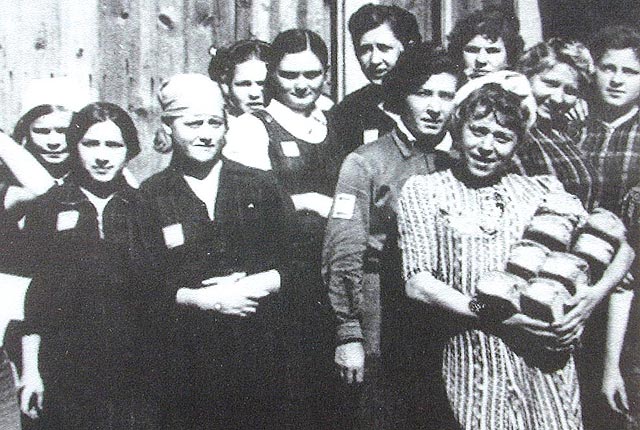
Die Franzosen waren überwiegend unter Druck (Entzug der Lebensmittelmarken) in Frankreich angeworben, die „Ostarbeiter“ fast durchweg verschleppt worden. Zwischen beiden Gruppen gab es erheblichen Unterschied – die „Ostarbeiter“ galten als „Untermenschen“ und waren deshalb in jeder Hinsicht gegenüber den „Westarbeitern“ benachteiligt. Und den „Ostarbeiterinnen“ ging es noch schlechter als den Männern. „Die Ostarbeiter hatten viel schlechtere Verpflegung als wir. Wir Westarbeiter haben häufig Brot über den Zaun des Ostarbeiterlagers geworfen. Ihr Lager wurde wie ein Kriegsgefangenenlager bewacht, und sie durften auch keine Gastwirtschaften besuchen“, erinnerte sich Christian Clermonts 43 Jahre nach Kriegsende an die Verhältnisse in Sindelfingen. Am lächerlich kleinen Beispiel der Tabakzuteilung wird die ganze Naziideologie deutlich: „Westarbeitern“ stand die Ration einer deutschen Frau zu, Polen und Russen die Hälfte davon, Polinnen und Russinnen bekamen nichts.
Bei Daimler beschäftigte Ostarbeiterinnen. Den Frauen ging es schlechter, als dieses offizielle Foto zeigt. (Foto: Mercedes-Benz Classic)
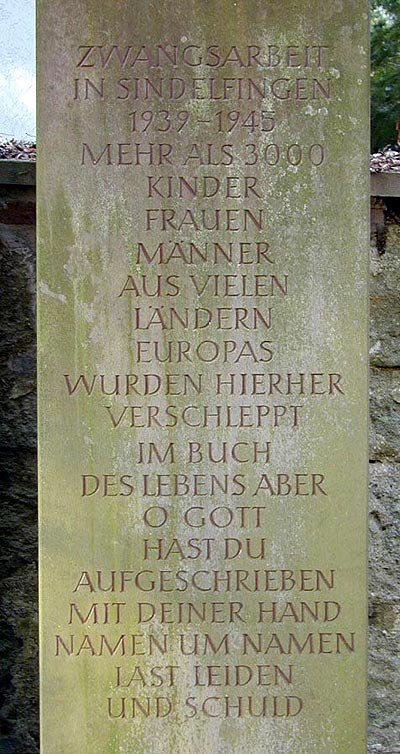
Das „Ost-West-Gefälle“ ging bis zum Tod: 53 Zwangsarbeiter sind in Sindelfingen gestorben. Von den 28 „Westarbeitern“ kamen 23 bei Bombenangriffen um, von den 25 „Ostarbeitern“ starben 23 an Krankheiten (an „Ernährungsstörung“ oder „Todesursache unbekannt“). Und von den 52 „Ostarbeiterkindern“, die in Sindelfingen geboren wurden, erlebten 19 das Kriegsende nicht. Dabei hatten es die Zwangsarbeiter bei Daimler Sindelfingen vergleichsweise besser als in vielen anderen Großbetrieben: Die Verpflegung war teilweise reichlicher als vorgeschrieben, auch die „Ostarbeiter“ durften – hart am Rande der Legalität – bei Luftangriffen den Stollen am Goldberg aufsuchen. Und viele Bürgerinnen und Bürger begegneten ihnen menschlich, teilweise unter Gefahr für sie selbst. Dennoch waren die Jahre in Sindelfingen für alle Zwangsarbeiter eine bittere und lange Zeit. Die Daimler-Benz AG hat sich 1988 zu ihrer Verantwortung bekannt und 20 Millionen DM an zuständige Organisationen gezahlt; in Untertürkheim steht heute ein Denkmal, das an die Zwangsarbeiter erinnert. Das offizielle Sindelfingen hat dieses Kapitel jahrzehntelang weggeschoben. Bis 1985 waren die Gräber verstorbener „Ostarbeiter“ auf dem Alten Friedhof in einem erbärmlichen Zustand, danach wurden zwei Sammelgräber mit Bronzeplatten eingerichtet. Und seit 1992 steht auf dem Alten Friedhof eine Gedenktafel für die Sindelfinger Zwangsarbeiter.
Späte Entschädigung
Heute, fast 54 Jahre nach Kriegsende, sollen die Zwangsarbeiter endlich entschädigt werden – aber die ungleiche Behandlung geht offenbar weiter: Die „Ostarbeiter“, die mehr leiden mussten, sollen zum Ausgleich weniger bekommen. Ein früherer Zwangsarbeiter in der Ukraine oder in Russland hat es im Leben zumeist schwerer gehabt als sein Kollege aus dem Westen. Warum soll er also nicht – zumindest – in gleicher Höhe entschädigt werden?
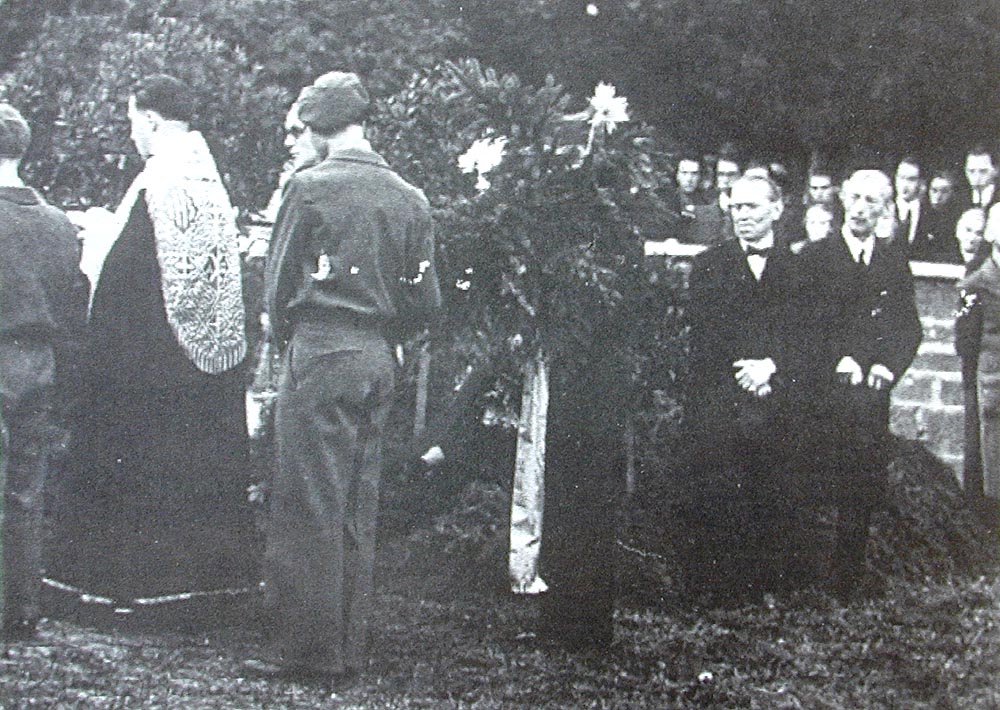
Beerdigung der bei einem Luftangriff gestorbenen holländischen Zwangsarbeiter. (Foto: Mercedes-Benz Classic)
Quelle: Das 20. Jahrhundert im Spiegel der Zeit. Der Kreis Böblingen im Rückblick von 100 Jahren. Röhm Verlag Sindelfingen 1999, S. 96.
"Die wissenschaftliche Aufsatzsammlung thematisiert Zwangsarbeit in der Rüstungsindustrie bei der Firma Daimler-Benz. Besonders berücksichtigt werden Polen, ""Ostarbeiter"", Juden, KZ-Häftlinge, Westeuropäer, Italiener/italienische Militärinternierte und Kriegsgefangene. Das Buch enthält ausführliche Texte, Fotos und Bilder."
The use of forced labour and slavery in Nazi Germany and throughout German-occupied Europe during World War II took place on an unprecedented scale. It was a vital part of the German economic exploitation of conquered territories. It also contributed to the mass extermination of populations in German-occupied Europe. The Nazi Germans abducted approximately 12million people from almost twenty European countries; about two thirds came from Central Europe and Eastern Europe. Many workers died as a result of their living conditions – extreme mistreatment, severe malnutrition, and worst tortures were the main causes of death. Many more became civilian casualties from enemy (Allied) bombing and shelling of their workplaces throughout the war. At its peak the forced labourers comprised 20% of the German work force. Counting deaths and turnover, about 15 million men and women were forced labourers at one point during the war
Whether 10,000 Russian females fall down from exhaustion while digging an antitank ditch interests me only in so far as the antitank ditch for Germany is finished.
Street round-up (Polish łapanka [waˈpanka]) of random civilians to be deported to Germany for forced labour; Warsaw's Żoliborz district, 1941
Foreign forced labourers
Numbers
10 million (1944 est.) including: 6.5 million civilians 2.2 million POWs 1.3 million camp inmates
Abducted
12million
Place of origin
USSR (33.6%), Poland (21.7%), France (17.1%), Belgium, Netherlands, Czechoslovakia, Yugoslavia, Italy, Bulgaria, Hungary, Denmark, Greece, Spain, Romania and others
Foreign civilian forced labourers in Nazi Germany by country of origin, January 1944 with transfer payment to the Reich per labourer Source: Beyer & Schneider
UnternehmenJahrBetrag in DMEmpfängerGrundI.G. Farbenindustrie AG195730 Miojüdische und nicht-jüdische ZwangsarbeiterWollheim-Prozess in FrankfurtKrupp-Konzern195910 Miojüdische Zwangsarbeiter aus KonzentrationslagernVorbereitung einer Sammelklage in New YorkAEG-Telefunken19604 MioZwangsarbeiterVermeidung eines Präzedenzfalles aus SammelklageSiemens19627 Miojüdische ZwangsarbeiterJewish Claims Conference legte firmen-internen Bericht von 1945 vorRheinmetall19662,5 Miojüdische Zwangsarbeiter (nicht-jüdische lehnte das Unternehmen 1969 ab)zur politischen Absicherung eines Waffengeschäftes mit den USADeutsche Bank für Flick-Konzern19865 MioZwangsarbeiter des Flick-Unternehmens Dynamit Nobelzur politischen Absicherung des lukrativen Weiterverkaufs Dynamit Nobel durch Deutsche BankDaimler Benz1988?20 MioFörderung von Alten- und Pflegeheimenunbekannt